Abstract
Authors: Ankita Das, Harmandeep Singh, Catalin Gainaru, Alexei P. Sokolov, Kenneth S. Schweizer
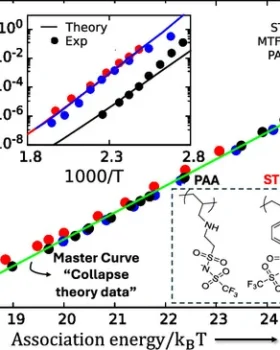
Abstract: Understanding the activated transport of ions in neat polymeric liquids and glasses is a fundamental scientific problem in materials, polymer, and physical chemistry, and it is highly relevant for diverse energy storage applications. Of special interest are cation-based single ion conductors, “polymerized ionic liquids” (PolyILs). We combine three recent advances in microscopic statistical mechanical theory for multiscale structure, ion hopping, and polymer segmental dynamics to address how structural correlations, thermodynamic state, and anion–cation association strength determine the temperature-dependent activation barrier for ion transport and its coupling with polymer motion. The key is a new mapping of molecular complexity to a coarse grained model that encodes the chemically specific glass transition temperature, Tg , polymer persistence length, vitrification density, and anion–cation attraction strength. Quantitative comparisons with the mobile Li ion relaxation times of PolyILs with a Triflouromethane Sulfonimide (TFSI) anion, and predictions for a theoretically designed model with a lower Tg and Coulomb attraction, are presented. New core results include a critical Coulomb strength being required for the onset of ion activated motion and a master curve over 15 decades of hopping rate based on a temperature-dependent effective anion–cation association energy that encodes variations of polymer flexibility, Coulomb strength, temperature, and density. The strong role of correlated polymer dynamical fluctuations in facilitating ion hopping is established.