Design through computation, theory, and materials informatics.
The crosscut goal is to leverage fundamental knowledge obtained from the Thrusts to enable the design of fast ion conducting polymer and polymer-ceramic electrolytes.
Key questions
- How can representation learning be utilized to combine experimental and simulation data to discover high-performing polymer electrolytes with superior charge transport?
- How can theoretical and computational approaches with vastly different data types be combined in an interconnected, seamless, multiscale manner to predict bulk and interfacial properties critical for fast, cooperative ion-conducting polymer-based electrolytes?
-

Database of Nonaqueous Proton-Conducting Materials
ACS Appl. Mater. Interfaces 2025, 17, 16901
Publication Date: 20250309 -
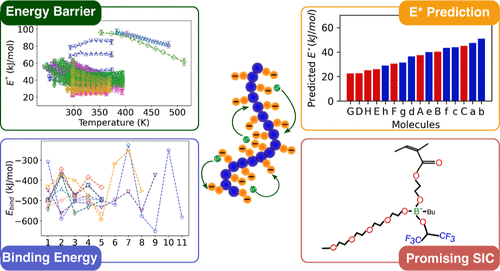
Using Data-Science Approaches to Unravel Insights for Enhanced Transport of Lithium Ions in Single-Ion Conducting Polymer Electrolytes
Chem. Mater. 2024, 36, 11934
Publication Date: 20241206 -

Large Language Models as Molecular Design Engines
J. Chem. Inf. Model. 2024, 64, 7086
Publication Date: 20240904