Abstract
Authors: Ankita Das, Catalin Gainaru, Alexei P. Sokolov, and Kenneth S. Schweizer
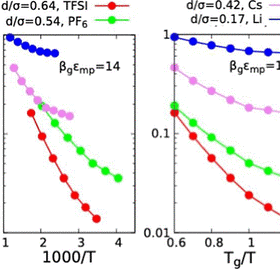
Abstract: We construct a microscopic statistical mechanical theory of collective dynamical effects on the conductivity of polymerized ionic liquids as quantified by the inverse Haven ratio. A central result is that the complex activated dynamics of single ion hopping, which fully determines the ion self-diffusion constant, cancels out to leading order in the inverse Haven ratio. The key physics lies in how strong collective microstructural correlations on the Coulomb cage scale mediate correlations in space and time of forces between pairs of mobile ions. The dominant force correlation pathway is associated with strong cation–anion attractions and how their space-time correlation is related to the mobile ion Coulomb cage order parameter. Excluded volume constraints also play a very important role for larger ions, but are a relatively weak effect for small ions. This results in strong suppression of ionic conductivity and the inverse Haven ratio at the glass transition temperature with increasing ion size. For large ions, the theory predicts a strong increase of the inverse Haven ratio as the anion–cation attraction weakens or there is charge delocalization on the monomer, but far weaker effects for the smaller ions. The effect of polymer backbone stiffness is modest. Interestingly, as a hypothetical but instructive exercise, if one ignores the dynamical consequences of Coulomb attractions and only considers force correlations between repulsive mobile ions, the theory predicts PolyILs with small ions such as Li and Na can exhibit inverse Haven ratios larger than unity as occurs in superionic ceramics. In contrast, for large ions the behavior remains basically the same, establishing the critical importance of excluded volume induced dynamical correlations in reducing their conductivity. Overall, the theoretical predictions for the absolute magnitude and evolution with cooling or densification of the inverse Haven ratio are consistent with experiments.