Abstract
Authors: Debjyoti Bhattacharya, Yifan Liu, Valentino R. Cooper, Wesley F. Reinhart
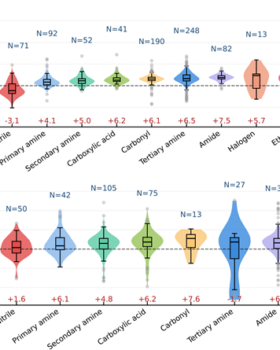
Abstract: Accurate gas-phase proton affinities (PAs) are essential for designing proton carriers in anhydrous fuel cells, yet high-level quantum-chemical calculations are too expensive for large libraries. We develop a multi-fidelity Δ-learning framework that corrects PM7 semi-empirical estimates toward high-fidelity references using only PM7 electronic properties and cheminformatics descriptors, without DFT-derived features. On a 1155-molecule NIST WebBook benchmark, an ExtraTrees model correction reduces the PM7 mean absolute error (MAE) from 8.21 to 2.87 ± 0.26 kcal mol−1, a 47% reduction over a calibrated PM7 baseline of 5.44 ± 0.39 kcal mol−1. A DFT-descriptor-based model trained to the same experimental targets yields 3.17 ± 0.24 kcal mol−1, demonstrating that PM7-based features achieve comparable accuracy while avoiding DFT cost at inference. We extend Δ-learning to the harder task of site-specific prediction against a B3LYP/def2-TZVP reference, across 251 diverse molecules and 821 site-matched protonation sites, reducing the raw PM7 error from 10.26 to 7.44 ± 1.00 kcal mol−1, versus 8.23 ± 1.02 kcal mol−1 for calibrated PM7. Functional-group and SHAP analyses identify correction patterns and high-variance cases where direct DFT remains preferable. We then apply the RandomForest model in a seven-stage workflow screening for candidate anhydrous proton carriers, combining similarity retrieval, PM7+Δ-ML prediction, Claude Opus 4.6-assisted preliminary donor–acceptor motif screening, and Pareto selection. From 821 435 filtered ZINC molecules, 30 candidates were DFT-validated, of which 29 fall within the target window (210–235 kcal mol−1). Applied prospectively to these 30 molecules, the correction lowers the raw PM7 error from 13.51 to 3.99 kcal mol−1. The DFT PA window, motif check, and functional-group exclusion retain 26 candidates, and the five ranked highest by DFT proton affinity span 226.6–234.3 kcal mol−1, at or above the 225.3 kcal mol−1 PA of imidazole. These single-molecule calculations prioritize candidates for experiment but do not by themselves establish condensed-phase proton conductivity.