Abstract
Authors: Hongwei Li, Qinyu Zhu, Yuya Shinohara, Yangyang Wang, Panagiotis Christakopoulos, Autumn Kudlack, Zitan Huang. Peter V. Bonnesen, Changwoo Do, Md Anisur Rahman, Michelle Lehmann, Tomonori Saito, Ralph Colby, Rajeev Kumar, and Jodie Lutkenhaus
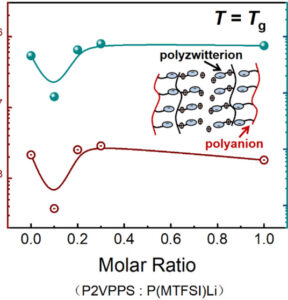
Abstract: Solid polymer electrolytes (SPEs) hold great promise for the advancement of next-generation energy storage devices. However, the ion transport mechanism in SPEs remains poorly understood. In this study, we investigate blends of poly(1-(3-sulfonatopropyl)-2-vinylpyridinium) (P2VPPS) and poly(lithium (trifluoromethane)sulfonimide methacrylate) (P(MTFSI)Li) of varying molar ratios to develop a mechanistic understanding of ionic conductivity in a miscible polyzwitterion/polyanion system. Polyanions can act as single-ion conductors, but conductivity is often prohibitively low due to the decreased segmental mobility and ion aggregation. Here, it is hypothesized that the introduction of a polyzwitterion would competitively interact with the polyanion charge groups to realize improvements in the conductivity. Attractive interactions between the polyanions and polyzwitterions are confirmed by the blend’s increased glass transition temperature using the Gordon–Taylor equation. Notably, an ordered local nanostructure (∼24 Å) emerged in the P2VPPS/P(MTFSI)Li system at certain compositions, as characterized by small-angle X-ray and neutron scattering (SAXS/SANS). Concurrent with the emergence of this structure, broadband dielectric spectroscopy confirmed improvements in ionic conductivity. The highest conductivity is observed at a specific blend ratio P2VPPS:P(MTFSI)Li = 0.2:1 in the glassy state and 0.3:1 in the rubbery state, corresponding to the lowest effective activation energy (E*). Coarse-grained molecular dynamics simulations further emphasize the role of complexation between polyzwitterion and polyanion chains, correlating with the emergence of a new peak in SAXS and SANS for the blends. This work provides a fresh perspective on the role of local structural design in developing SPEs and offers insights into the morphological effects on ionic conductivity.