Abstract
Authors: Harmandeep Singh, Mary Danielson, Ryan Peterson, Ivan Popov, Alexei P. Sokolov, Tomonori Saito, Md Anisur Rahman, and Catalin Gainaru
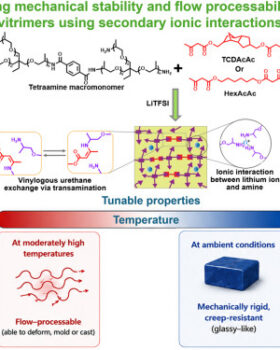
Abstract: It is well established that the macroscopic flow of dynamic covalent networks involves mesoscopic rearrangement of crosslinkers; however, its relationship with local, segmental motions remains under debate. In this vein, the present study investigates how tuning the segmental (α) dynamics using salt doping impacts the viscoelastic behavior of two vinylogous urethane-based vitrimers. Our analyses show that additional ionic interactions significantly slow down the α relaxation in these materials, driving them into the glassy state at room temperature, while having a much weaker impact on their global dynamics. This disparity allows the separation of the individual contributions of segmental dynamics and network rearrangements to their terminal flow. In addition, our results demonstrate that tuning segmental dynamics, as an alternative to the popular approach of adjusting network rearrangements, can be used for the development of vitrimers that are mechanically rigid and creep resistant at ambient conditions yet flow-processable at moderately high temperatures.