Abstract
Authors: Harmandeep Singh, Ivan Popov, Michelle L. Lehmann, Md Anisur Rahman, Kenneth S. Schweizer, Rajeev Kumar, Tomonori Saito, Alexei P. Sokolov, and Catalin Gainaru
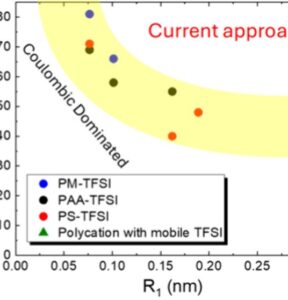
Abstract: The development of polymer electrolytes for energy storage and conversion technologies requires a fundamental understanding of the material parameters controlling the energy barriers for ion transport. In glassy polymers, these activation barriers are usually extracted by using Arrhenius procedures. However, our recent studies of single ion conducting polymers reveal that this traditional Arrhenius description provides anomalously small prefactors, an issue that is widely disregarded in the literature. To address it, an alternative approach was introduced for extracting the effective activation barrier E by imposing a physically valid limit (∼10–13 s) for the ion hopping attempt time. Two consequences of this recent approach are that in polymer electrolytes (i) E is significantly (∼30–40%) lower than the barrier estimated using traditional Arrhenius fits and (ii) E displays significant temperature dependence even in the glassy state. Under these circumstances, we are revisiting the role of ion size, glass transition temperature Tg, and dielectric and elastic constants of the polymer matrix on the effective activation barriers for ion transport as extracted using the recently proposed approach and highlight the differences from the picture that previously emerged based on simplistic apparent Arrhenius analysis. To this end, we investigate cation transport in three families of single ion conducting trifluoromethane sulfonimide-based polyanions with varied Tg. Our results indicate that E decreases with mobile cation size and is highly sensitive to changes in the dielectric permittivity of the matrix, even for large cations. These insights call for revisions of many earlier results based on apparent Arrhenius fits as the proposed approach can provide more accurate guidance for the design of polymer electrolytes with enhanced ionic conductivity.