Abstract
Authors: Catalin Gainaru, Harmandeep Singh, Ivan Popov, Rajeev Kumar, Kenneth Schweizer, and Alexei P. Sokolov
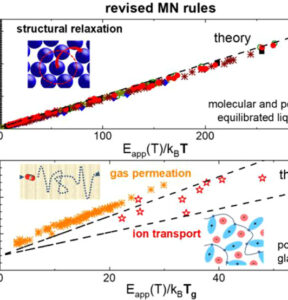
Abstract: Understanding activation barriers controlling structural relaxation in glass-forming liquids, molecular transport, and ionic conductivity in amorphous polymers is a grand challenge of fundamental scientific and materials engineering interest across disciplines. Over decades, intriguing but puzzling empirical correlations between the elementary time scale of activated barrier crossing and the apparent Arrhenius activation energy, the so-called Meyer−Neldel (MN) rules, have been discovered in diverse liquids and glasses. Here, we formulate and successfully apply a new experimental analysis and an explicitly dynamical theoretical framework which provides an understanding of the origin, validity, and failure of such correlations, that bridge and unify the three fields of structural relaxation, molecular transport, and ionic conductivity in liquids and quenched glasses. Distinct quasi-universal laws are predicted in equilibrated liquids and nonequilibrium glasses, consistent with experiments. Our analysis reveals that even if the relaxation appears Arrhenius over a limited temperature range, the physical activation barrier is generally temperature-dependent in polymeric systems even below glass transition temperature. In addition, we show that the approximate validity of classical MN rules hinges on a linear temperature dependence of this barrier and the temperature range probed in experiments. Our findings are relevant for controlling the activation barrier in functional soft polymeric materials relevant to molecular separations, barrier coatings, and charge transport, and also provide new constraints on the theoretical understanding of the mechanism underlying slow activated dynamics in glass-forming condensed matter.